

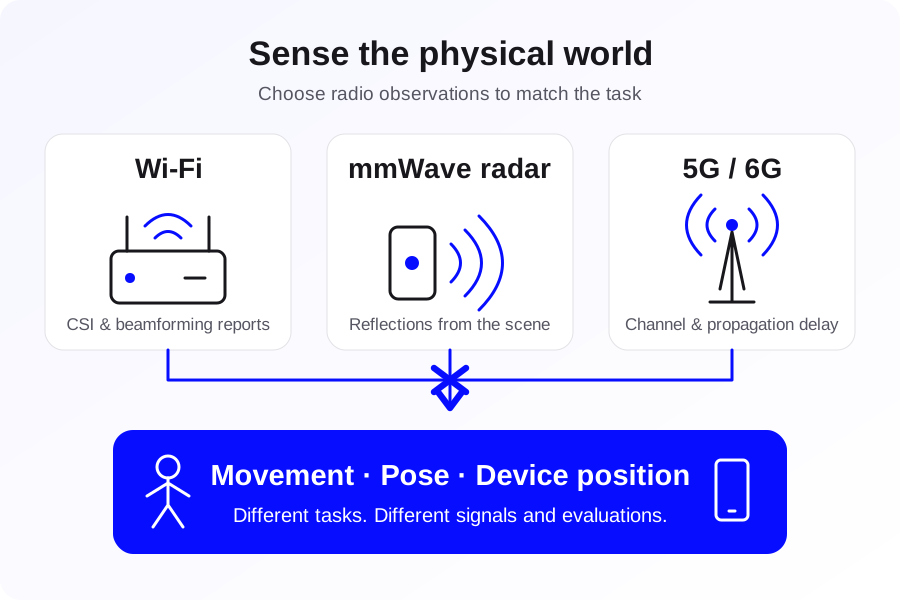
Radio signals change as they travel through a space and interact with people and objects. We study how these observations can help us understand movement, human pose, and device position, alongside their role in communication.
Questions we can explore together
- How can we observe human movement where cameras or wearable sensors are difficult to use?
- What information can existing wireless devices provide beyond data communication?
- Can observations at a 5G base station support device positioning or an understanding of the surrounding environment?
Recognizing a person's activity and locating a wireless device are different tasks. They require different signals and evaluation methods. We begin by defining what you need to observe, then examine what the available radio measurements can tell us.
From radio observations to useful information
Our work examines changes in Wi-Fi and millimeter-wave signals as clues to activity, posture, and the state of a space. These observations include channel state information (CSI), which describes a wireless channel, and compressed beamforming reports exchanged by Wi-Fi devices.
We also investigate sensing and positioning with 5G/6G radio signals. Directions include using channel measurements and signal propagation delay observed at base stations, and developing experiments with srsRAN while looking toward 6G. These are research directions to evaluate for a particular task and environment.

Research examples
Counting repeated movements with Wi-Fi
CBR-ACE studies how compressed Wi-Fi beamforming reports can be used to count repeated human exercise movements. It explores sensing through information exchanged by wireless devices.
Estimating human pose with radar
RAPTR investigates radar-based 3D human pose estimation. It is another example of using radio observations to understand how people move.
Exploring positioning with 5G signals
Our 5G device-positioning work examines CSI together with signal propagation delay. The choice of measurements, experimental platform, and evaluation conditions determines what can be assessed in each study.
These methods differ in whether a device or tag is needed, the movements they target, and the required placement of equipment. We relate the available observations to the required accuracy and evaluate how performance changes across rooms and users.
What a joint study could evaluate
| Conditions to define | Questions to evaluate |
|---|---|
| Activity, device position, or another target | Which signals are needed, and what level of detail can they provide? |
| Wireless equipment and observation points | How can measurements be collected, and are device modifications necessary? |
| People, obstructions, and changes of room | How do recognition or positioning errors change in unfamiliar environments? |
| Communication and sensing together | What are the observation rate, processing time, and effects on communication? |
For equipment installations and living spaces, we also agree on the purpose and scope of the information collected. This helps us design experiments around the information the application actually needs.
International research connections
Our broader JST ASPIRE collaboration with Dinesh Bharadia and UC San Diego's WCSNG explores wireless networks for groups of autonomous mobile systems. The public annual report (PDF, in Japanese) describes the collaboration's scope and activities.